from basedpl import bpl, fn, Array, plus, tally
import numpy as npPython
Native arrays, callable functions and Python conversions.
Native arrays
bpl is the BPL workspace. It keeps its names for the life of the Python process. Calling it returns a native basedpl.Array. Its immutable data retains nesting, exact numbers and empty-array prototypes. Use .np or .py to convert it.
v = bpl('1 2 4')
v
1 2 4Python operators use BPL’s array semantics. Precedence follows Python, which multiplies before adding:
v * 2 + 13 5 9Indexing counts from 0, as in Python. Negative positions count from the end. A full : selects an axis. Iteration yields rows of a matrix rather than individual items:
a = bpl('2 3⍴⍳6')
a.shape, a[0, :], a[:, 1], a[:, -1], list(a)
((2, 3), [0., 1., 2.], [1., 4.], [2., 5.], [[0., 1., 2.], [3., 4., 5.]])BPL also exposes functions by their word names. plus.reduce is +/, and plus.reduce.each is +/¨. Applied to this nested vector, +/¨ sums each item:
nested = bpl('[[1 2] [3 4 5]]')
nested
(1 2⋄3 4 5)In Python, chain the corresponding word functions:
plus.reduce.each(nested)3 12f = plus.reduce.each
f(nested)3 12Python integers become exact values. Functions compose too: plus.reduce / tally builds the mean function +/÷≢. Its result is still a native array, even when it holds a single number:
exact = Array([1, 2, 4])
mean_native = plus.reduce / tally
mean_native(exact)7ᵣ3The native representation uses Python numeric notation: 2 is exact and 2. is approximate. .bpl returns the BPL display as a string:
v.bpl, exact.bpl('1 2 4', '[1 2 4]ₓ')The workspace
bpl is shared by the whole Python process, including the notebook magics. bpl(']clear') removes every name and restores the starting display settings.
Calling bpl returns a native array or function and prints explicit BPL output. It suppresses implicit BPL display. Use .np or .py when you need a converted result:
bpl('3 3⍴⍳9').nparray([[0., 1., 2.],
[3., 4., 5.],
[6., 7., 8.]])Module and bpl attributes give the builtins by name. For example, bpl.add(2+3j) conjugates, bpl.plus(2) adds 2, and bpl.times(2) doubles. Word functions explains the names:
bpl.add(2+3j).py, bpl.plus(2)(3).py, bpl.times(2)([1, 2, 3]).py((2-3j), 5, array([2, 4, 6], dtype=uint8))Keyword arguments bind Python values in the workspace. Square brackets read a BPL expression or assign a value:
bpl(x=np.arange(1, 6))
bpl['v'] = [3,1,4,1,5]
bpl['<v'].np
array([1, 1, 3, 4, 5], dtype=uint8)fn makes a composable Function from a BPL function expression. It is the same as bpl.fn. Pass one argument for a monadic call or two for a dyadic call. Python integers stay exact. .py converts this mean to a Fraction:
bpl('mean←{⍝ Mean of a vector\n+/⍵ ÷ ≢⍵}')
mean = fn('mean')
mean([1,2,4]).py
Fraction(7, 3)Names and help
Type mean? for its comment help and mean?? for BPL source. The same information is available programmatically:
mean.source, bpl.names('me')('{⍝ Mean of a vector\n+/⍵ ÷ ≢⍵}', ['mean'])See names and help for source lookup, erasure and inspection APIs.
fn is late-bound: fn("foo") follows later redefinitions of foo. Use bpl("foo") to retain its current function.
Calls print only explicit output (⎕← and display commands). Each output prints as soon as BPL produces it, before any later ⎕ prompt. A second argument of 'explicit' captures it instead, returning a Result with the native .value and the captured .output:
r = bpl('⎕←x ⋄ ≥x', 'explicit', x=3)
assert r.value.py == 4
assert r.output == ['3ₓ']
'repl' also captures implicit expression display, as the BPL prompt shows it. The %%bpl cell magic uses it. In ordinary Python notebooks, append ; to suppress display of a call’s return value.
Labelled arrays
data = [[10, 20, 30], [40, 50, 60]]
keys = ('NY', 'LA'), ('Jan', 'Feb', 'Mar')
sales = Array(data, axis_keys=keys, axis_names=('city', 'month'))
sales.axis_names, sales.axis_keys
(('city', 'month'), (('NY', 'LA'), ('Jan', 'Feb', 'Mar')))Arithmetic matches named axes and aligns their keys, rather than relying on order. This adjustment lists the months backwards but still adds 1 to January, 2 to February and 3 to March in each city. .df copies the result to pandas, preserving labels; install pandas to use it.
months = 'Mar', 'Feb', 'Jan'
adjustment = Array([3, 2, 1], axis_keys=(months,), axis_names=('month',))
(sales + adjustment).df| month | Jan | Feb | Mar |
|---|---|---|---|
| city | |||
| NY | 11 | 22 | 33 |
| LA | 41 | 52 | 63 |
Plots
plot draws a chart from an array. Keys label the x axis and the legend, and axis names become the axis titles. Keyword arguments set the chart’s options, with a dictionary for each nested option:
legend = {'position': 'top-left'}
bpl.plot(sales, mark='bar', title='Sales by city', legend=legend)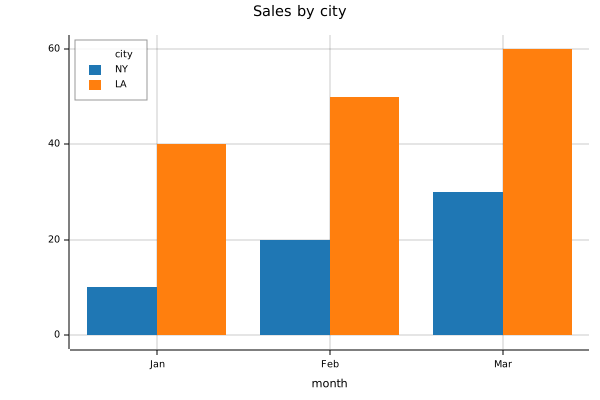
A dict of equal-length lists is a table. Its x column supplies the x values, and every other column is a series. Plots lists all the settings.
threads = [1, 2, 4, 8, 16, 32]
seconds = [30.1, 15.8, 8.2, 4.4, 2.5, 1.6]
bpl.plot({'x': threads, 'seconds': seconds}, mark='point', labels=1,
    x={'title': 'threads', 'scale': 'log'}, y={'scale': 'log'})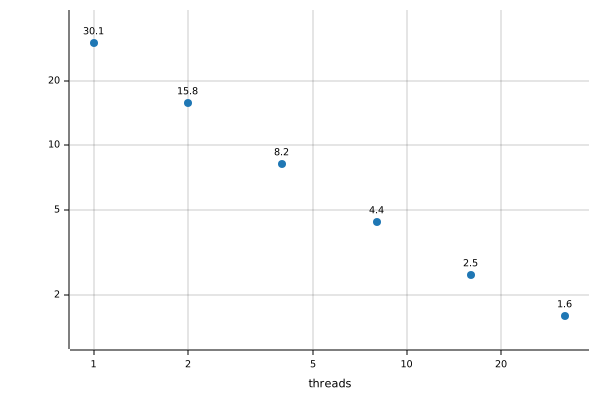
Values and conversion
Array retains atoms, shape, nesting, numeric domain and empty prototypes. An atom and a scalar both have .shape == (). .is_atom is True only for an atom. .bpl gives the BPL display. .py converts atoms to Python values and character vectors to strings. Other arrays become NumPy arrays, including scalars. .np always returns an ndarray.
For axis-keyed arrays, .py returns a dict at rank 1 and a pandas DataFrame at higher ranks. .np copies the values. Attach labels with Array(data, axis_keys=[rows, cols]); use None for an unkeyed axis. .axis_keys returns a tuple of label tuples or None.
axis_names names dimensions; axis_keys names positions within them. Matching axis names align before positional broadcasting. .axis_names returns one name or None per dimension.
from basedpl import Array, plusm = Array([[1, 2, 3], [4, 5, 6]], axis_names=('city', 'month'))
v = Array([10, 20, 30], axis_names=('month',))
assert (m + v).np.tolist() == [[11, 22, 33], [14, 25, 36]]
assert plus.reduce['month'](m).np.tolist() == [6, 15]
assert plus.reduce['month'](m).axis_names == ('city',).df converts any array to a DataFrame. The last axis gives the columns. The earlier axes give the rows, as a MultiIndex above rank 2. Unkeyed axes are labelled from 0. Install pandas for this conversion. Pandas is imported on demand.
Axis names become pandas index/column names, including MultiIndex level names.
from fractions import Fraction
from basedpl import Array
assert Array(2).bpl == '2ₓ'
assert Array(2.).bpl == '2'
assert Array(Fraction(1, 3)).py == Fraction(1, 3)| Python input | BPL value |
|---|---|
bool, NumPy Booleans |
Boolean |
int, NumPy integers |
Exact number |
float |
Approximate real, at the default width |
Fraction |
Exact rational |
complex |
Approximate complex |
str |
Character vector |
| Rectangular list/tuple | Ordinary array |
| Ragged list/tuple | Nested array |
| NumPy ndarray | Array preserving shape and numeric domain |
dict with string keys |
Keyed vector, recursively. .py returns a dict |
.np or np.asarray(a) always produces an ndarray. Booleans use bool. Integers use the width BPL stores them at: uint8, int16, int32 or int64. Floats use the width BPL stores them at, float16, float32 or float64. A NumPy float16 or float32 array keeps its width in BPL. Complex numbers use complex128. Fractions, large integers, nested arrays and mixed exact and approximate values use object. Character arrays use U1. The arrays inside a .py result, and the columns of a .df result, use the same dtypes.
import numpy as npa = Array([[1, 2, 3], [4, 5, 6]])
np.testing.assert_array_equal(a.np, [[1, 2, 3], [4, 5, 6]])Python/NumPy conversions copy. Passing an Array back to BPL shares its immutable value. Keep Array to preserve empty prototypes and exact nesting. NumPy is needed only for ndarray conversion.
Array operations
Arithmetic uses BPL agreement, aligning leading axes. Indexing starts at 0, and negative positions count from the end. : selects a whole axis.
np.testing.assert_array_equal(a + [10, 20], [[11, 12, 13], [24, 25, 26]])
np.testing.assert_array_equal(a[1, :], [4, 5, 6])
np.testing.assert_array_equal(a[:, [0, 2]], [[1, 3], [4, 6]])
np.testing.assert_array_equal(a[:, -1], [3, 6])
Comparisons return arrays. % computes the residue with Python’s operand order. // is floor division. @ is the matrix product. & and | give the LCM and GCD, which are AND and OR on Booleans. len and iteration use major cells. Use member(x, y) for membership. Bounded slices aren’t supported.
Callable functions
.fn() creates a callable BPL function. One argument supplies ⍵, and two supply ⍺ and ⍵. Arguments pass directly as values.
mean = bpl.fn('{+/⍵ ÷ ≢⍵}')
assert mean([1, 2, 4]).py == Fraction(7, 3)
assert mean([1., 2., 4.]).py == 7 / 3

add = bpl.fn('+')
np.testing.assert_array_equal(add([1, 2, 3], 10), [11, 12, 13])
.fn('g') follows later redefinitions of g. bpl('g') keeps the function that g holds now.
import basedpl as bKeyword arguments become ⍺, as a keyed vector. Positional arguments become ⍵. One positional argument is ⍵ itself, several form a vector, and none gives ⍬. System functions take their options as ⍺. In Python, pass those options as keyword arguments. Element functions take attributes the same way:
circle = b.element('circle')
orange = circle(cx=30, cy=50, r=20, fill='orange')
blue = circle(cx=70, cy=50, r=20, fill='steelblue')
pic = b.svg(orange, blue, width=200)
pic
The keyword arguments became attributes. System functions read keyword arguments as options:
b.xml.undo(circle(r=10)), b.json('{"a": null}', fill=0)('<circle r="10"/>', {'a': 0})CSV options work the same way. nget and nput read and write files, as in b.nput(text, path='copy.csv'):
table = b.csv('price,qty\n10.5,2\n20.0,4\n')
text = b.csv.undo(table, separator=';').py
b.csv(text, separator=';').py
{'price': array([10.5, 20. ]), 'qty': array([2, 4], dtype=uint8)}r compiles a regex into keyed functions, which Python indexes by name:
p = b.r(r'([a-z]+)([0-9]+)')
p['replace']('$2:$1', 'ab12')12:abFunction vectors, such as [+ × ÷], retain callable handles. Indexing with a single position, first and pick return the selected function:
from basedpl import first, pickfs = bpl('[+ × ÷]')
assert pick(1, fs)(2, 3).py == 6
assert first(fs)(2, 3).py == 5Array([f, g]) also constructs a function vector. .py and object-dtype .np export a function vector’s items as Python callables.
f.source returns the BPL source. f.inspect() returns the source and help. bpl.names(prefix, classes) lists visible bindings. bpl.inspect(name) reads a name or glyph. IPython supports f?, f?? and name completion in bpl strings. See names and help.
A user operator comes back as an Operator, whether it’s a workspace name or a field of a record from •load. Call it with its operand, or both operands of a dyadic operator, to get a Function. Bind an Operator like any other value:
bpl('again←{⍶ ⍶ ⍵}')
again = bpl.again
assert again(bpl.fn('≥'))(3).py == 5
bpl['repeat'] = again
assert bpl('-repeat 3').py == 3
again
{⍶ ⍶ ⍵}Word functions
Each builtin has Python names, available as attributes of basedpl and bpl and as imports from basedpl. Glyphs and glyph names, such as add, dash, mul and div, take either valence, as functions from .fn() do. Operation names, such as plus, subtract, times and divide, select a valence. Called with one argument, a dyadic operation name binds the right argument. .left(x) binds the left argument instead.
from basedpl import plus, times, subtract, tally, add, πassert times(2)(3).py == 6
assert subtract(2)(5).py == 3 # 5−2
assert subtract.left(2)(5).py == -3 # 2−5
mean = plus.reduce / tally
assert mean([1, 2, 4]).py == Fraction(7, 3)assert add(2).py == 2
assert b.divide(2)(3).py == Fraction(3, 2)
assert π(1).py == np.piLookup accepts a glyph, a glyph name, an operation name or an alias. Use underscores for hyphenated names, and a trailing underscore for Python keywords, as in not_. A glyph that is a legal Python identifier, such as π, works directly. Get other glyphs with getattr(bpl, '+'). System functions also accept names without •. When names clash, existing Python attributes come first, then operation names, then glyph names, then system names. Lookup uses only exact registered names and aliases. An unknown name raises AttributeError.
A workspace name is also an attribute of bpl when no builtin has that name. After plus←99, bpl.plus is still +, and bpl['plus'] gives 99. dir(basedpl) lists the builtins, and dir(bpl) also lists workspace names.
assert bpl.multiply(2, 3).py == 6
assert bpl.index_of([4, 2, 7], [7, 4]).py.tolist() == [2, 0]
assert getattr(bpl, '+')(2, 3).py == 5
assert bpl.add(1+2j).py == 1-2j
assert bpl.plus(2)(3).py == 5
assert bpl.mul(-2).py == -1
assert bpl.times(2)(3).py == 6
assert bpl.distribution('normal')['cdf'](0.).py == 0.5
Names distinguish valences: sign/times, shape/reshape, iota/index_of, first/take, mix/pick. times(2.) binds an approximate number, and times(2) binds an exact one. Operators use the underlying BPL function.
exponential and exponent name the monadic and dyadic forms of *. power names the operator ⍣, exposed as f.power(n).
basedpl.symbols is the shared naming table used by Python functions and REPL and notebook completion. Each row is a dict with the keys glyph, name, kind, monad, dyad, aliases and shortcut. name is the glyph’s canonical name. kind is one of function, monadic-operator, dyadic-operator, argument, literal, comment, system or syntax. monad and dyad hold a function’s monadic and dyadic names, or "" where it has no form of that valence. Both are empty for every other kind. aliases holds space-separated extra completion aliases. shortcut is the REPL’s formatted key suffix, derived from layout.json: " h" for Alt-h, " o c" for Alt-o then c, or "" when absent. The table is directly JSON-serializable for JavaScript consumers.
| Python | BPL |
|---|---|
f.reduce, f.scan |
f/, f\ |
f.each, f.commute |
f¨, f⍨ |
f.outer_product, f.dot(g) |
f⊗, f.g |
f.key, f.stencil(s) |
f⌸, f⌺s |
f.rank(r), f.atop(g) |
f⍤r, f∘g |
f.after(g), f.over(g), f.before(g) |
f↢g, f⍥g, f↣g |
f.power(n) |
f⍣n, with n a count, a list of counts, ∞ or a predicate |
f.history(n) |
f⍣(⍳≥n) for a count, f⍣[g] for a predicate |
f.undo, f.inverse_pair(g), f.under(g) |
f⁻¹, f⇄g, f@g, with g a function, positions or [p] |
f.valences(g) |
f⊘g: f with one argument, g with two |
f.agenda(g) |
f⍚g: the result of f picks which function in the vector g runs |
f.derivative |
f∂ |
f[k] |
f⍠k, axes k |
Operator properties chain in BPL order: subtract.commute.reduce is -⍨/. Operators needing another operand retain a hole until supplied:
twice = times(2)
assert twice.power.each(3)([1, 2]).py.tolist() == [8, 16]  # twice⍣3¨
f.power.each(n) constructs (f⍣n)¨, just like f.power(n).each. For multiple missing operands, successive calls fill the innermost construction first: f.power.each.power(n)(m) constructs ((f⍣n)¨)⍣m. Complete the operands before passing evaluation arguments.
Arithmetic between functions makes forks: f+g is (f+g). f @ g is inner product. f << g is the Atop f∘g, and f >> g is g∘f. f ** n is power. Python’s precedence applies when building these expressions.
Math families: prime/prime_mode (⍭), factors/factor_spec (⨸), roots/polyval (⌻). windows is dyadic ↕.
Roots: sqrt/root (√). Complex coordinates: real_imag (∨), polar (∧), cis (○). pi_times/pi_ratio (π) give π multiples/fractions. Also square, double, decrement, increment, classify, binary_encode and binary_decode.
from basedpl import prime, factors, polyvalassert prime(9).py == 29
np.testing.assert_array_equal(factors(700), [2, 2, 5, 5, 7])
p = polyval.left([1, 2, 3])
assert p(2).py == 17
assert p.derivative(2).py == 14
np.testing.assert_array_equal(p.derivative([10, 20], [1, 2]), [80, 280])
np.testing.assert_array_equal(plus.left(1).history(3)(0), [0, 1, 2, 3])Printing functions
to_python(f) shows a function using Python word names and combinators.
from basedpl import to_python, plus, times, tallyassert to_python(plus.reduce / tally) == 'plus.reduce / tally'
assert to_python(times(2.)) == 'times(2.)'
assert to_python((plus.reduce / tally).each) == '(plus.reduce / tally).each'For an ambivalent function, dyad=True selects the dyadic spelling. Word functions already specify their valence.
assert to_python(bpl('×')) == 'sign'
assert to_python(bpl('×'), dyad=True) == 'times'
assert to_python(bpl('2-')) == 'subtract.left(2.)'
assert to_python(bpl('{⍵×2}¨')) == 'fn("{⍵×2}").each'
Dfns and late-bound .fn(...) expressions retain their BPL source. Use bpl('+/÷≢') to evaluate a function expression and print its assembled structure. Printing itself never executes BPL. Approximate 2 prints as 2., exact 2ₓ as 2, and fractions as Fraction(...). Complex array constants retain BPL notation inside bpl(...).
The output is explanatory Python spelling. Python argument evaluation order and workspace definitions remain the caller’s responsibility.
Parsing source
parse gives the parse tree of BPL source, for tools that read and rewrite it. Each line of its display shows a node’s kind, its span of character offsets into the source, and its own source text:
from basedpl import parsetree = parse('m←[1 2 ⋄ 3 4] ⋄ (4 ⋄ 4 5)')
treeProgram 0:25 'm←[1 2 ⋄ 3 4] ⋄ (4 ⋄ 4 5)'
Statement 0:13 'm←[1 2 ⋄ 3 4]'
Name 0:1 'm'
Assign 1:2 '←'
ArrayLiteral 2:13 '[1 2 ⋄ 3 4]'
Cell 3:6 '1 2'
ArrayLiteral 3:6 '1 2'
Cell 3:4 '1'
Literal 3:4 '1'
Cell 5:6 '2'
Literal 5:6 '2'
Cell 9:12 '3 4'
ArrayLiteral 9:12 '3 4'
Cell 9:10 '3'
Literal 9:10 '3'
Cell 11:12 '4'
Literal 11:12 '4'
Statement 16:25 '(4 ⋄ 4 5)'
ArrayLiteral 16:25 '(4 ⋄ 4 5)'
Cell 17:18 '4'
ArrayLiteral 17:18 '4'
Cell 17:18 '4'
Literal 17:18 '4'
Cell 21:24 '4 5'
ArrayLiteral 21:24 '4 5'
Cell 21:22 '4'
Literal 21:22 '4'
Cell 23:24 '5'
Literal 23:24 '5'Kinds are the parser’s node names, plus Program, Statement, Body for each dfn body, Cell for each array-literal cell, Comment and Error. Separators have no nodes. walk gives a node, then each of its descendants, in source order.
The text between two cells holds their separator. Node.edit gives a node’s text with each (span, new) pair replaced. basedpl.syntax.edit does the same for any text, such as a Markdown file that holds BPL. This rewrite removes the spaces around each ⋄ that separates rows, and leaves the statement separator alone:
def cell_gaps(tree):
    "The spans between consecutive cells of each array literal."
    for node in tree.walk():
        if node.kind != 'ArrayLiteral': continue
        cells = [c for c in node.children if c.kind == 'Cell']
        for a, b in zip(cells, cells[1:]): yield a.span[1], b.span[0]

def unspace_rows(text):
    tree = parse(text)
    return tree.edit((gap, '⋄') for gap in cell_gaps(tree) if text[slice(*gap)].strip() == '⋄')
fixed = unspace_rows('m←[1 2 ⋄ 3 4] ⋄ (4 ⋄ 4 5)')
assert fixed == 'm←[1 2⋄3 4] ⋄ (4⋄4 5)'
fixed'm←[1 2⋄3 4] ⋄ (4⋄4 5)'Comments are Comment nodes. A line that doesn’t parse becomes an Error node, whose error is the BplError, and parsing continues after it:
bad = parse('x←1   ⍝ one\n[1 2)\ny←2')
bad
Program 0:21 'x←1 ⍝ one\n[1 2)\ny←2'
Statement 0:3 'x←1'
Name 0:1 'x'
Assign 1:2 '←'
Literal 2:3 '1'
Comment 6:11 '⍝ one'
Error 12:17 '[1 2)'
Statement 18:21 'y←2'
Name 18:19 'y'
Assign 19:20 '←'
Literal 20:21 '2'[n.error.message for n in bad.walk() if n.kind == 'Error']['mismatched closing delimiter']Errors and interruption
BplError provides the diagnostic, kind, message, source, character span, call context and prior output. Completed assignments survive errors. A capturing call keeps its output on the exception. An ordinary call prints its output before raising.
Ctrl-C interrupts evaluation. From another thread, call bpl.interrupt(). bpl.timeout = 2 gives each evaluation a two-second deadline. None, the default, removes it.
Evaluation runs on the calling thread and releases the GIL. Other Python threads keep running during an evaluation. The workspace remains usable after interruption. Native-library calls can delay cancellation. For a hard-kill fallback, use a process worker.