avg←+/÷≢
avg 2 4 95BasedPL, the Based-array Programming Language, is an array language derived from APL, with ideas from J and BQN. Its notation aims to be simple and consistent. Most of this documentation calls it BPL. BPL is written in Rust and comes as a native executable, a Jupyter kernel and a Python API.
LLMs: read llms.txt first. It is the primary reference index and concise overview. In a BPL session, ]help llms shows the same file.
pip install basedpl
bpl
Each release also has a standalone bpl that needs no Python, for macOS on Apple silicon and for Linux on x86-64 and arm64. On a Mac:
curl -Lo bpl https://github.com/AnswerDotAI/basedpl/releases/latest/download/bpl-macos-arm64
chmod +x bpl
On Linux, download bpl-linux-x86_64 or bpl-linux-arm64 instead.
At the prompt, define a mean and apply it:
avg←+/÷≢
avg 2 4 95Use bpl -e 'avg←+/÷≢ ⋄ avg 2 4 9' for a shell command. The command-line guide covers source files and pipes.
In the REPL, type a backtick followed by a glyph name. For example, `iota becomes ⍳ when you press Tab or type a non-letter. Abbreviations and Alt-key shortcuts are available. ]help + shows help for +. •prefs changes display settings, such as boxes and how much of a large array shows. See REPL and the glyph reference, which lists each glyph’s key.
In Jupyter, select the installed BasedPL kernel. Cells share definitions and support completion, Shift-Tab help and interruption. You can also use %%bpl cells in a Python notebook. See Using BPL notebooks.
APL is a language built around operations on whole arrays and notation for combining functions. Here is a taste of that style in BPL.
Numbers separated by spaces form a vector. Arithmetic applies to every item:
10+1 2 311 12 13Operators modify or combine functions. Reduce (/) turns addition into summation. ⍳10 generates 0…9:
+/⍳1045Functions can also be combined without naming their arguments. In avg←+/÷≢, sum (+/) divided by tally (≢) defines the mean:
avg 1 2 3 42.5To see how these ideas express an algorithm, start from “a prime has exactly two positive divisors”. Form all remainders of 1 to 50 (|⊗⍨↦50), count the zeros down each column (+⌿0=), and find the positions (⍸) whose count is two. Positions count from 0. ≥ increments each position to recover its number:
≥⍸2=+⌿0=|⊗⍨↦50[2 3 5 7 11 13 17 19 23 29 31 37 41 43 47]ₓGetting started builds a primes function from the same divisor count, step by step, and displays the divisibility matrix along the way.
For APL users, some key differences are:
[a b c] is a vector, and a+b × c+d is (a+b)×(c+d). A run that ends in a function is a train. For example, +/÷≢ x is the mean of x, and 2× doubles its argument. 0⌷v and v₀ both select the first item of v.Positions and axes count from 0, as in BQN and Python. Approximate comparisons use tolerance 1E¯14. See the language principles for why BPL works this way, the glyph reference for Dyalog differences and Arrays for the array model.
Bare numbers are approximate. Use ₓ for exact integers and r for exact fractions:
1r3+1r61ᵣ2Complex numbers use j between real and imaginary parts. Functions such as square root extend into the complex domain:
√¯40ⱼ2See Numbers for conversion and mixed arithmetic.
Write matrix rows directly in an array literal. Leading-axis agreement lets a vector supply one offset per row:
m←[1 2 3
   4 5 6]
m+10 20
11 12 13
24 25 26See array notation and broadcasting.
Axes can have names, and positions along them can have string keys. Describe the axes once, then select by key or reduce by axis name:
axes←["city":"NY" "LA";"month":"Jan" "Feb" "Mar"]
sales←axes:[10 20 30⋄40 50 60]
"LA" "Feb"⌷sales
+/⍠"month" sales50["city":2]⍴["NY":60 "LA":150]Keys and names travel with axes through operations such as transpose. Arithmetic aligns matching names and keys. See Axis keys.
A vector of counts keeps the history: one state for each count, where count 0 is the initial value. Here, double up to four times:
2×⍣(⍳5) 11 2 4 8 16Under (@) transforms the argument, applies a function, then reverses the transformation. Scale by ten, floor, and scale back to round down to tenths:
⌊@ 10× 1.25 2.781.2 2.7Explore iteration and inverses, Under, windows and function selection.
Primes and factorisation are built in:
⨸360ₓ[2 2 2 3 3 5]ₓPolynomials support coefficients, roots and evaluation. Polynomial functions can be differentiated: for f(x) = 1 + 2x + 3x², f′(2) = 14.
f←[1 2 3]ₓ⌻ ⋄ f∂2ₓ14ₓProbability distributions provide sampling, density, CDF and quantiles. Two fair coin tosses give these probabilities for 0, 1 and 2 heads:
coin←2 0.5 •distribution "binomial"
coin.density 0 1 2
0.25 0.5 0.25Matrix division handles linear systems and least squares.
JSON objects become keyed arrays, with dot access to their fields:
order←•json "{""price"":10.5,""qty"":2}"
order.price×order.qty21CSV headers likewise name column vectors. Files, CSV and JSON covers reading, transforming and writing data. Regex supplies matching, captures and replacement through Rust’s regex engine.
•plot draws charts from arrays. Keys label the axes and name the lines. See Plots.
["legend":"end"]•plot sales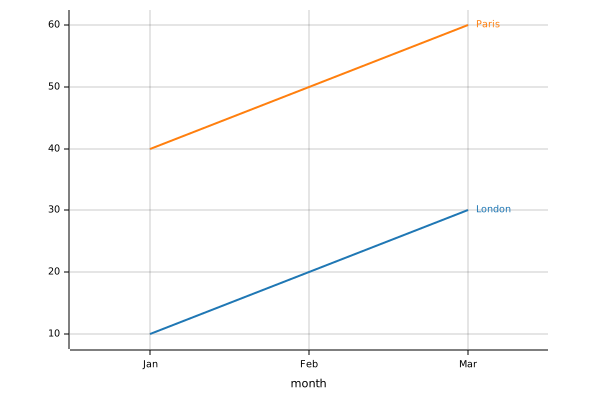
Build SVG from element functions and keyed attributes. Notebooks display the picture directly. The same element trees serialize to XML. See XML and SVG.
[circle text]←•element "circle" "text"
c←["cx":50 "cy":40 "r":25 "fill":"orange"]circle ""
t←["x":50 "y":85 "text-anchor":"middle"]text "Hello, SVG"
["width":240 "height":240]•svg c t
BPL functions are Python callables:
from basedpl import fn

mean = fn('+/÷≢')
mean([1, 2, 3])
Arrays have .py, .np and .df conversions for Python values, NumPy and pandas. Functions also have Python names and composition operators. See the Python tutorial.
For other frontends, the process interfaces provide JSON messages and interruptible workers. The BPL library contains more algorithms, codecs, interpreters and puzzles.